

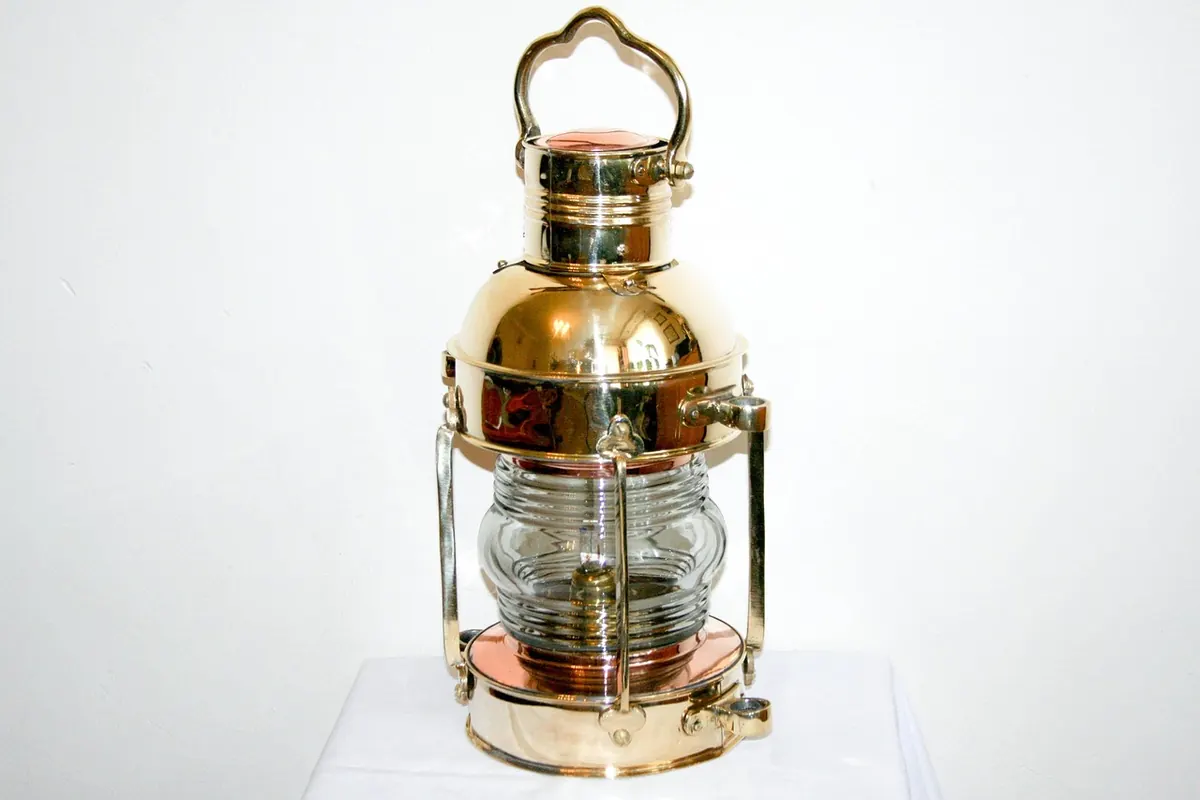
Brass lanterns age at different rates depending on where they have been. One that hung in a damp coal shed for sixty years will look and feel very different from an identical lantern that spent the same time in a dry loft. That is why dating is never a single measurement. It is a reading of several clues — the marks, the metal, the glass and the burner — weighed against one another. Get two of them agreeing and you can usually place a lantern within a decade or two, which is about as precise as this gets without a paper trail.
Begin with the marks
Maker's marks are the fastest route to a date, but only if you find them. They are rarely in the obvious place, and a lantern may carry three or four different stamps left by the maker, the retailer and the company that used it. Look in all of these spots:
- The base plate and the underside of the reservoir
- The burner collar, where names are often stamped in letters barely a millimetre high
- Inside the reservoir, beneath the burner — the most commonly missed location
- The door frame or the hinged side of a lamp box
- A small brass plate riveted to the frame, typical of railway, dock and ships' lanterns
Names you may come across include William Sugg & Co, Sherwood, Tilley, Aladdin and Veritas on the lamp side, and Dietz or Feuerhand on imported examples. Glass is sometimes marked too — Chance Brothers of Smethwick supplied a great deal of British lantern glass. Read the lettering carefully as well as the words. Cast-in names, where the letters are part of the metal, tend to belong to earlier mass production. Crisp stamped lettering in a plain sans-serif face usually points later. Patent dates are the most useful clue of all, because a lantern cannot predate its own patent — though it can be made long afterwards. Registered design numbers, stamped as an "Rd" followed by digits, can be checked against the national registered designs records, which are held in public archives and increasingly indexed online.
Reading patina and honest wear
Brass is an alloy of copper and zinc, and it changes with time in ways that are difficult to fake convincingly. Genuine patina is uneven. It is darkest in crevices, in the folds of a pressed bracket and around solder joints, while the high points that were handled or polished stay brighter. On lanterns kept outdoors you may find verdigris — the soft green corrosion that copper-rich alloys develop in damp conditions — gathered in joints where water sits.
A uniform chocolate-brown coating spread evenly over every surface, inside and out, is more likely to be a chemical treatment applied last week. So is a bright, almost pinkish shine with no variation at all.
Wear tells you how it was used
Look at the knurling on the wick adjuster. Decades of thumb pressure polish it smooth on one side. Look at the inside of the reservoir: a paraffin lamp usually retains a faint oily smell, however long it has been dry. Soot staining around the burner collar suggests years of lighting and extinguishing. Mismatched brass tones on different parts — a darker burner on a lighter frame — often mean a replacement, which is completely normal in a working lantern and tells you it was used rather than displayed.
Glass: the quiet giveaway
Glass is the most frequently replaced part of any lantern, so treat it as supporting evidence rather than proof. Hand-blown glass has small bubbles and fine ripples, a slightly wavy surface and an uneven rim. Moulded glass, which became steadily more common through the nineteenth century, is crisper, with more regular curves and often a visible seam. Patterns such as bullseye, diamond and ribbed designs were produced over long periods, so the pattern alone rarely dates an object.
Etched or embossed trade names are more useful, because brand names have known histories. Ruddy amber and coloured glass tends to appear on older railway, marine and signalling lanterns, where the colour mattered as much as the light. If the glass is machine-perfect and the brass around it is heavily patinated, you are probably looking at a replacement.
Burner design and the date range it suggests
The burner is where lantern technology leaves its clearest fingerprints.
Wick burners
Flat-wick burners with a simple wheel adjuster belong to the paraffin era, broadly from the mid-nineteenth century onwards. Duplex burners, which carry two flat wicks side by side and are usually adjusted by two small wheels, are a mid-Victorian development. Round "cosmos" wick burners, with a single knurled wheel on a central tube, point towards the late nineteenth and early twentieth centuries. Early hint: if the adjuster wheel is knurled brass, the lantern is likely older than one fitted with a pressed-steel or early plastic wheel.
Mantle and pressure lamps
Incandescent mantle burners, giving a much brighter white light, came into use in the late nineteenth century and dominated the following decades. Pressure lamps with a hand pump and a small spirit cup for preheating are twentieth-century equipment. If you find a pump, a pressure gauge or a preheater, you are almost certainly in the 1900s or later.
Later conversions and fixings
Many brass lanterns were converted to electric light in the 1920s and 1930s. A bulb holder, a drilled hole with a rubber grommet and a length of old flex are all signs of a working life that carried on past the paraffin age. Small details help here too. Slotted screws suggest an earlier date; Phillips and Pozidriv heads point to the twentieth century, and usually to the post-war years.
Style, shape and the period trap
Silhouette is a useful first impression but a poor final answer. Early Victorian lanterns tend to be ornate, with decorative cast brackets and plenty of applied detail. By the 1890s and 1900s, frames became simpler and squarer. The 1920s and 1930s brought geometric outlines, thinner profiles and, on some pieces, chrome plating over brass. The trap is that popular patterns stayed in catalogues for decades. A design first sold in 1895 may have been made well into the 1930s, so style should confirm a date rather than set it.
A workable method for dating a lantern
- Photograph it in daylight from every side, including the base, the burner and the inside of the reservoir.
- Write down every mark exactly as it appears, punctuation included, and note whether the letters are cast or stamped.
- Check any patent or registered design numbers against public registers before you guess.
- Examine the fixings — screw heads, rivets, hinges — for signs of later repair or replacement.
- List what has clearly been replaced: glass, wick, seals, burner, screws.
- Compare your lantern with catalogue reprints, museum collections and specialist reference books.
- Write your conclusion as a range, such as 1890–1910, rather than a single year.
Cleaning, care and an honest verdict
Resist the urge to strip a lantern back to bright metal. That hard-won patina is part of its age and part of its character, and abrasive polishes remove both. A soft dry cloth, a little warm water on stubborn dirt and a dry environment will do more good than any chemical. If you intend to burn a vintage paraffin lantern, have the burner, seals and washers checked first, use only the fuel it was designed for, and never light one you are unsure about. Age is only one factor in what a lantern is worth — rarity, condition and provenance matter at least as much. If money or insurance is involved, ask a specialist dealer or auctioneer for a valuation rather than relying on a date stamp. And if you simply want a date, accept a considered range. That is what the evidence honestly supports.
Photo: Marynistyka_Group / Pixabay